
SSH Zones — one installation, many trust domains
Source:
docs/ssh/zones.md
Introduced by [decision-017](https://github.com/oriolrius/pki-manager-web/blob/main/backlog/decisions/decision-017 - SSH-Zones-—-Multi-CA-Grouping-and-Trust-Boundary.md). If you run a single SSH trust domain you can ignore this page — nothing changes for you. A migrated single-zone install behaves exactly as before.
What a zone is
Section titled “What a zone is”A zone is a first-class grouping of SSH trust material that is a real trust boundary, not a UI label. It lets one PKI Manager run N independent SSH trust domains — prod vs staging, customer A vs customer B, datacenter vs lab.
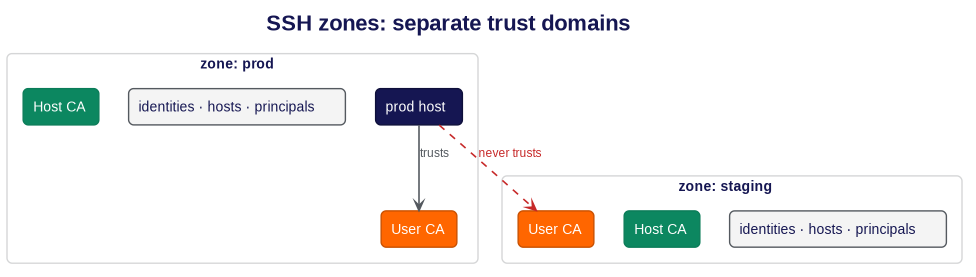
Before zones, the SSH manager had exactly one User CA and one Host CA for the whole installation, and every host trusted every user CA. With zones:
The trust boundary — the one rule that matters
Section titled “The trust boundary — the one rule that matters”A host in zone Z trusts only the user CAs of Z. Concretely:
- Each zone holds its own
activeUser CA andactiveHost CA (rotation is unchanged — oneactive+ onerotatingper(zone, type)). - A host’s composed KRL, its
TrustedUserCAKeysfile and its@cert-authoritylines are all derived from that host’s zone. A revocation in one zone never appears in another zone’s hosts. - Host certificates are signed by the Host CA of the host’s zone; user certs by the User CA of the identity’s zone. You never pass a CA id into issuance — the zone comes from the subject entity.
Membership rules
Section titled “Membership rules”| Aspect | Rule |
|---|---|
| Zone name | a globally-unique URL-safe slug (prod, staging); default is seeded by the migration |
| CA cardinality | one active + one rotating per (zone, ca_type) |
| Host / identity | belongs to exactly one zone (a hard partition — no cross-zone entity) |
| Uniqueness | fqdn, identity subject and principal name are unique per zone, so the same web1.example.com can exist in prod and staging |
| One person, two zones | needs two identity rows (one per zone) and two principal-grant sets — the deliberate price of a hard boundary |
| Zone change | not an update — zone_id is immutable; offboard + re-enroll to move a host or identity |
| Deletion | impossible while the zone owns any CA/host/identity/principal (ON DELETE RESTRICT) — archive instead |
Archived zones
Section titled “Archived zones”Archiving a zone (status='archived') blocks new CAs, hosts, identities,
principals and certificate issuance in it, and hides it from pickers. It does
not stop serving existing trust material: trust downloads, KRL generation and
ECIES pulls keep working, so archiving never locks operators out of hosts that
are still running. Un-archive to resume.
Using zones
Section titled “Using zones”- UI: a persisted zone switcher in the SSH section header (with an
explicit All zones view that adds a Zone column). Create forms require a zone,
prefilled from the switcher. Manage zones at
/ssh/zones(create, rename the display name, archive, un-archive). - tRPC: the
ssh.zonerouter (list/get/create/update/archive/unarchive); every SSH list procedure takes an optionalzoneIdfilter; every create/issuance-adjacent procedure takes an optionalzone(id or slug). - REST:
/api/v1/ssh/zonesCRUD;?zoneId=on the list endpoints; azonefield on the create bodies. - Public trust endpoints: zone-scoped
/ssh/zones/:zone/{trusted-user-ca-keys,host-ca-keys,cert-authority}are authoritative. The legacy unscoped routes keep serving the default zone with aDeprecationheader so already-enrolled hosts never break.
Fail-closed resolution (why an un-scoped call can start erroring)
Section titled “Fail-closed resolution (why an un-scoped call can start erroring)”Every call that omits a zone resolves it fail-closed:
- exactly one non-archived zone exists → that zone (so single-zone installs, the CLI, the Ansible role and existing scripts keep working untouched);
- several zones exist and none was named → the call fails loudly, listing the available zone slugs, rather than silently signing with the wrong trust domain’s CA.
So the moment you create a second zone, start passing zone/zoneId (or the
--zone flag / KRL_CLIENT_ZONE) to anything that was relying on the implicit
single zone.
The ECIES KRL route and ambiguous FQDNs
Section titled “The ECIES KRL route and ambiguous FQDNs”POST /api/v1/external/ssh/krl has no app auth (ECIES is the authentication) and
resolves the host by FQDN alone. Because FQDNs are now unique only per zone, if
the same FQDN exists in several zones the route returns 409 AMBIGUOUS_HOST;
pass an optional zone in the body (or krl-client --zone /
KRL_CLIENT_ZONE) to disambiguate. Single-zone installs, and multi-zone installs
with distinct FQDNs, are unaffected.
Downstream consumers not updated by this milestone
Section titled “Downstream consumers not updated by this milestone”oriolrius.pki_managerAnsible collection (Galaxy, pinned>=2.3.0) — it uses the legacy unscoped trust endpoints and the external API, which keep serving the default zone. It works unchanged for the default zone; a zone-aware release (passingzoneto the module) is follow-up work in that repo. Multi-zone fleets driven by Ansible need per-zone tokens and, for the ECIES path,krl-client --zoneon hosts whose FQDN collides across zones.pki-manager-cli(sibling Python CLI, generated from the OpenAPI spec) — needs a client regeneration to expose the/ssh/zonesendpoints and the?zoneId=/zonefields. Until regenerated it drives the default zone only.krl-client(in-repo) is already zone-aware via--zone/KRL_CLIENT_ZONE/zone:— see its README.
Explicitly deferred (decision-017)
Section titled “Explicitly deferred (decision-017)”These are deferred, not forgotten — none is implemented by this milestone:
- Cross-zone trust import (
zone_trusted_cas) — v1 has no cross-zone trust; if ever needed it is additive (an explicit import table, never an implicit union). - Per-zone OIDC RBAC (e.g.
ssh-admin:prod) — zone admin is not yet scoped by OIDC role. - X.509 adoption of
zone_id— thezonestable is deliberately generic so CAs/certificates/clusters can adopt it later, but they do not yet. - Moving a host or identity between zones as an in-place update — forbidden; offboard + re-enroll.
- Multi-zone identities via a membership table — rejected for now; re-addable later without touching existing rows.
→ Back to how it works · Upgrading a live install: Zones migration runbook